Sustainable Secret Santa Gifts: Eco-Friendly Ideas That Get Used

In short
The most sustainable Secret Santa gift is the one your match actually uses, eats or keeps, so start from their habits, not from an eco label. Dependable low-waste picks are consumables, second-hand finds in good condition, reusables that fit a habit, local makers' goods, experiences and pet-friendly plants (non-toxic per the ASPCA), from a few dollars to about $50. Wrap in fabric or plain paper, and offer the idea to your group as one friendly suggestion.
| Gift type | Typical spend | Works best when | Main catch |
|---|---|---|---|
| Consumables (food, soap, seeds) | $3-$25 | You know little about your match | Allergies, diets and alcohol |
| Second-hand finds | $2-$30 | You know their taste | Condition, cleaning and safety |
| Reusables that fit a habit | $12-$35 | You have seen a habit of theirs | Useless if they own one already |
| Local makers' goods | $8-$25 | The exchange is in person | Small-shop prices run higher |
| Experiences | $10-$50 | Your match lives nearby | Vouchers expire unused |
| Pet-friendly plants (ASPCA non-toxic) | $0-$18 | They have a bright windowsill | Pet toxicity, winter transport |
By January, some of what sat on the Secret Santa gift table has moved to a drawer: the slogan mug, the battery-hungry desk gadget, the thing shaped like a pinecone. Not all of it, since some gifts do get used, but enough. That drawer is what a sustainable Secret Santa is really trying to fix.
Here's the encouraging part. Low-waste gifts are often cheaper than novelty ones and easier to buy for someone you barely know. The catch is that “eco-friendly” on a label tells you very little, and a preachy group message can sour the whole exchange before anyone has shopped.
Below you'll find four questions that sort any gift idea, six kinds of low-waste gifts with prices, plastic-free wrapping and wording to suggest it to your group. Prices are typical ranges, and your group's cap always wins: the Secret Santa budget guide covers the usual caps.
What makes a Secret Santa gift sustainable?
A Secret Santa gift is sustainable when it gets used, used up or kept, and doesn't end up as clutter. Nothing is truly zero-waste, so the goal is low-waste, and the part you control is whether a gift lands in a drawer.
That's the whole mindset: useful beats novel. A novelty gift is built for one laugh at the exchange, which is also the last time anyone thinks about it. A useful one earns a place in someone's kitchen, bag or bookshelf. Four quick questions sort most ideas:
- 1Will they use it within a month? If you can't picture where it goes in their week, keep looking.
- 2Does it replace something or just add something? A better version of what they use beats a fifth copy.
- 3Can it be used up, repaired or passed on? Food gets eaten, a good knife gets sharpened, a book gets lent.
- 4Does the packaging outlast the gift? If the box is the biggest part, look for a less-wrapped version.
How do you find out what your match would use? Ask. The Secret Santa questionnaire has questions to send before the draw, and the private link in your draw email opens an anonymous chat with your gift recipient, where you can ask about allergies, pets or “what would you actually use up this winter?” without giving yourself away. The chat sends no notifications, so nothing pings your match when you write: send the question as soon as your own draw email arrives, then look back for the answer a few days later.
Which low-waste gifts are almost always welcome?
Gifts that get used up come closest to zero-waste: food, soap and seeds leave only a jar or a paper wrapper behind and nothing for the drawer. They're also the safest sustainable gift for a near stranger, since you only have to avoid allergies, not guess a taste.
- Bar soap or a solid lotion bar from a local maker ($6-$12). No plastic bottle, but watch for strong scents.
- Maple syrup, olive oil or honey from a small producer ($12-$25). Honey isn't vegan.
- Seasonal citrus or apples in a cloth bag ($10-$20). The bag gets reused, and the fruit should be eaten within a couple of weeks.
- Nuts, dried fruit or a spice blend from a bulk store, in a clean jar ($8-$15). Nut allergies are common, so ask first.
- Seed packets, herbs or wildflowers, in a small tin ($3-$8). A cheap extra for anyone with a garden or a sunny sill.
Two habits keep consumables from becoming waste themselves. Ask about allergies and diets in the chat, and keep alcohol opt-in because of company policies and personal choice. Then buy for what the person actually eats, not for what looks pretty: a beautiful jar they'll never open is waste with better packaging.
On a tight budget, one item plus a jar is plenty, and gifts under $10 has more picks at that price. If you'd rather make the food yourself, DIY Secret Santa gifts covers recipes, jars and allergen labels.
Which reusable gifts will people actually use?
Reusable gifts get used when they match a habit you've already noticed. A reusable only beats a disposable if it replaces the disposable many times, so one your match won't reach for is simply more stuff.
Tote bags, water bottles and travel mugs are the reusables everyone thinks of first, so plenty of people own several. Give one only when you've seen they lack it (no cup on the desk, a bag falling apart); otherwise match a habit instead:
| Habit you've noticed | Reusable that fits | Typical spend |
|---|---|---|
| Brings lunch from home | Steel or glass lunch container with a tight lid | $15-$30 |
| Hosts friends or eats at a desk | A set of cloth napkins or kitchen towels | $12-$25 |
| Fixes a button or loves an old jacket | Mending kit: sharp scissors, good thread, darning needle | $12-$25 |
| Remotes, controllers or kids' toys eat batteries | Rechargeable AA or AAA set with a charger | $20-$35 |
Okay, but not every sustainable classic earns its reputation. Beeswax wraps are handy for covering a bowl, but they have care limits (cool water, no heat, not for raw meat), and they only help someone who reaches for them. Give them to the person who already grumbles about plastic wrap.
With a bigger budget, one well-made item beats three small ones, and the guide to Secret Santa gifts under $50 makes that case in detail.
How do you give second-hand without it feeling cheap?
Choose things that age well, check each one the way you would a new one, clean it, and wrap it as carefully as anything else. A second-hand gift is low-waste because the object already exists, so it's the strongest move when you know your match's taste and have a few weeks to look. Thrift stores, consignment shops, flea markets, library book sales and online resale marketplaces all work.
What are the best things to buy second-hand?
Hard-wearing items work best. These prices are typical for thrift stores; antique and vintage shops charge more.
| Item | Typical price | What to check |
|---|---|---|
| Hardcover book on a topic they like | $2-$8 | Intact spine, no musty smell, no stained pages |
| Cast-iron skillet | $10-$30 | No cracks or wobble; light rust scrubs off |
| Linen napkins or a tablecloth | $3-$12 | No stains or thin patches; wash first |
What should you never buy second-hand?
Anything personal, anything you can't test and anything where safety rules have moved on:
- Underwear, swimwear and used makeup or skin products.
- Electrical items you can't test, especially anything with a frayed cord or a heating element.
- Old dishes meant for food or drink. Antique, worn or flea-market pottery, and handmade pieces with a crude or irregular look, can leach lead from the glaze. Keep vintage pieces for display.
- Used children's products you haven't checked for recalls, and safety gear such as helmets and car seats, which are safer bought new.
The U.S. Food and Drug Administration's guidance on lead in pottery says no amount of washing or boiling removes lead from a problem piece. For children's items, the Consumer Product Safety Commission's recall search takes a minute.
What should you check before you wrap it?
Four steps turn a thrift find into a gift:
- 1Look at it in daylight for chips, stains and cracks, and smell it. Smoke and mildew are the usual dealbreakers.
- 2Test anything that plugs in, turns or opens, and make sure every piece is there.
- 3Clean it: wash textiles, scrub metal and glass, and peel off price stickers (cooking oil loosens the residue).
- 4Add one small new thing, like a jar of jam or a card saying where you found it, so the gift reads as chosen, not found.
Some people don't like used gifts, so make second-hand welcome rather than required. If your whole group wants it as the rule, the Thrift Store Find theme in Secret Santa themes shows how to run it, including when to start the hunt.
Do experiences, local makers and plants make good low-waste gifts?
Yes, with one condition each: the experience has to be redeemed, the maker's goods used, and the plant safe for the home it lands in. All three leave almost nothing behind, and all three fail the same way, by sitting unused.
Experiences and donations that need no wrapping
- A museum, gallery or garden day pass ($10-$25). Easy to tuck into a card.
- Two movie or small-theater tickets ($20-$40). Above most office caps, but fine among friends.
- A drop-in class such as pottery, cooking or climbing ($25-$50). Best for friends and family budgets.
- A donation in their name ($10-$25), but only to a cause they've told you they care about.
Check the expiry date and choose something within a short trip of their home. A voucher that expires unused is the least sustainable gift on this page. To skip objects entirely, the charity exchange in these gift exchange formats shows how a whole group can swap donations instead.
Are local makers the easiest ethical gift?
Often, because you can ask the maker. Holiday markets, farmers markets and independent shops sell soap, honey, preserves, prints and knitwear in November and December, usually for $8 to $25, and the maker can tell you what's in an item and who made it. That's the simplest route to an ethical gift, though local doesn't automatically mean lower-impact: a local gift can still be overpackaged or made of imported materials.
Can you give a plant if your match has a pet?
Yes, if you check the species first. The ASPCA lists rosemary, basil, thyme, spider plants and Christmas cacti as non-toxic to cats and dogs, so those are the safe starting points.
| Plant | Cats and dogs | Typical spend | Note |
|---|---|---|---|
| Rosemary | Non-toxic | $6-$12 | Needs bright light; easy to overwater |
| Basil or thyme | Non-toxic | $3-$8 | Basil struggles on dim sills; thyme is tougher |
| Spider plant | Non-toxic | $0-$15 | Forgiving; a rooted baby is free |
| Christmas cactus | Non-toxic | $8-$18 | Often blooms in late fall or winter |
| Lilies | Dangerous to cats | $8-$20 | Skip for any home with a cat |
| Amaryllis, aloe, mint, chives, poinsettia | Toxic to dogs and cats | $4-$25 | Skip unless you know there are no pets |
Check anything else in the ASPCA's toxic and non-toxic plant database, which says its list isn't all-inclusive, and remember that even a non-toxic plant can upset a stomach if it's eaten. Not sure your match has pets? Ask in the anonymous chat, or give something that isn't a plant.
A plant that dies in January is waste with leaves on it, so ask about light or pick a tough one, and wrap the pot in paper against the cold. To grow the gift yourself, a rooted spider-plant baby or a pot of herbs costs almost nothing, and DIY Secret Santa gifts has the steps. For a remote exchange, skip plants and seeds, since carriers and customs often restrict them; the guide to hosting a virtual Secret Santa covers shipping timing.
How do you wrap a gift without plastic?
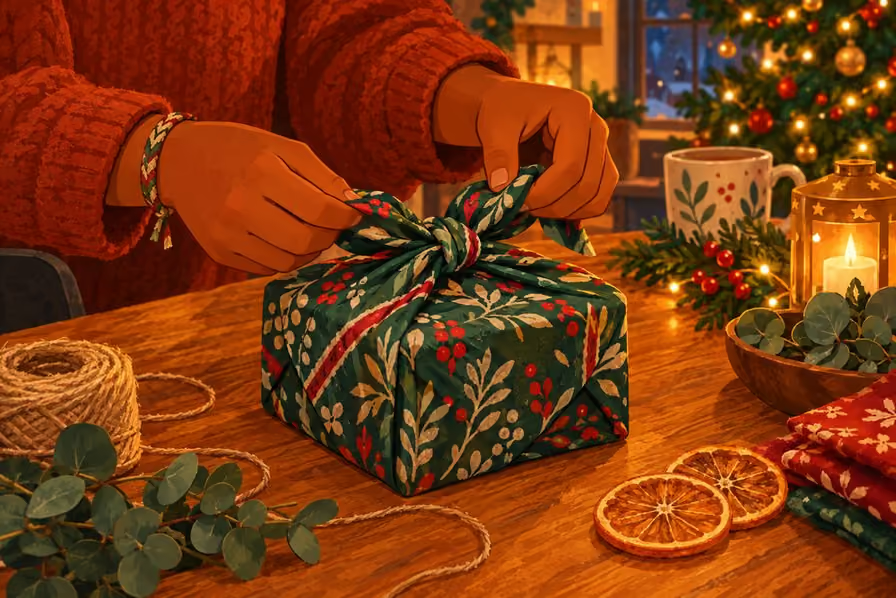
Use a square of fabric the recipient can reuse, or plain kraft paper tied with twine, and avoid glitter, foil, plastic ribbon and long strips of tape. Wrapping is the easiest part of a sustainable Secret Santa, because it costs almost nothing and nobody has to agree to it.
| Wrap | Typical cost | Why it works | The catch |
|---|---|---|---|
| Fabric square, furoshiki style | $0-$8 | Reusable, needs no tape, looks lovely | Only helps if it's kept |
| Kraft paper and twine | $2-$5 | Easier to recycle than glittery paper | Recycling rules vary by town |
| Newspaper, maps or sheet music | $0 | Free, and the print is the decoration | Thin, so double up on corners |
Furoshiki is the Japanese tradition of wrapping things in a square of cloth, and a basic version takes about a minute:
- 1Pick a square, and drape it over the gift before you commit. As a starting point, about 18 inches (45 cm) suits a small box and 28 inches (70 cm) suits a book or a larger box. A bigger cloth is more forgiving on a first try.
- 2Center the gift on the cloth, with the cloth set like a diamond.
- 3Bring the top and bottom corners up over the gift and tie them in a knot in the middle, tucking in any long ends.
- 4Tie the left and right corners together in a second knot just above the first. That makes a neat bundle with a built-in handle.
Thrifted scarves, cotton napkins, bandanas, tea towels and fabric remnants all work as wraps, and a scarf or tea towel can be the gift too. Add a note, “keep me, reuse me or pass me on”, and set out a basket at the exchange for cloth, bags and tags people want to hand back.
If you use paper, try the scrunch test: squeeze a sheet into a ball, and if it stays scrunched it's more likely to be recyclable. Glitter, foil, metallic and plastic-coated papers usually aren't, and ribbons and bows go in the trash, so tie with twine instead.
How do you suggest a sustainable Secret Santa without sounding preachy?
Offer it as an invitation, not a rule: pick one simple idea, explain it in practical terms and make sure it never costs anyone money or face.
- 1Pick one idea, not five. “Second-hand welcome” or “wrap without plastic” is a suggestion. “Zero waste, local, organic and fair trade only” is homework.
- 2Keep the budget the same. If low-waste gifts cost more, the tightest wallet in the group quietly loses. Count second-hand at the price you paid.
- 3Say welcome, not required. Some people dislike used gifts or can't get to a market, and a rule only works if everyone can follow it. Buying new and wrapping in paper still counts.
- 4Say it before the draw. Sent with the budget and date, an idea lands as part of the plan; sent after names are drawn, it feels like a correction.
If you draw names with a free Secret Santa generator such as Amazing Secret Santa, the event details have a budget field (up to 40 characters) and a group message of up to 500 characters, and both appear in every participant's email. Float the idea in the group chat first, then repeat it in the group message so it reads as a reminder, not a late correction. For general invitation wording, see these Secret Santa invitation templates. Here are two low-waste messages to copy:
Group chat invitation
Hi all! Secret Santa is on, and I'd love a low-waste twist this year, as an invitation, not a rule: second-hand, homemade, local or anything your person will eat, use or plant. A regular gift is fine too. Budget is $20 max. Names get drawn on date and we swap on date. Who's in?
Group message for the draw (under 500 characters)
A reminder of our low-waste welcome: second-hand, homemade, local, or something your person will eat, use or plant. A regular gift is fine too. The budget is a ceiling, and second-hand counts at what you paid. Wrap in fabric or plain paper if you can (no glitter or plastic, please). Not sure what your person likes? Ask in your anonymous chat, and check your own link now and then, since there are no notifications.
Where do sustainable and ethical labels overpromise?
They overpromise whenever a label says “eco-friendly,” “biodegradable” or “ethically made” without saying what is actually better. Naming those three claims keeps the idea honest without guilt-tripping anyone, yourself included:
- “Eco-friendly” or “green” with nothing behind it. Ask what, specifically, is better: the material, the packaging or the lifespan.
- “Biodegradable” or “compostable” plastic. Many such items break down only in industrial composting facilities, which not every area has.
- “Ethically made” with no maker or named standard behind it. Fairtrade certifies specific products, such as coffee and chocolate, and B Corp certifies whole companies. A named certification beats a leaf icon.
The U.S. Federal Trade Commission's Green Guides, which are guidance for marketers, make a similar point: unqualified general environmental benefit claims are hard to interpret and can mislead.
One more honest limit: a Secret Santa swap is a small part of anyone's footprint, and no gift is zero-impact. The goal isn't a perfect score. It's to stop buying things nobody wanted. If a gift lands that breaks every idea here, say thank you first, then rehome it quietly.
What does a low-waste Secret Santa look like from invitation to exchange?
Announce the idea with the date and budget, draw names, ask your match what they would use, shop second-hand and market finds first, and wrap in fabric or plain paper. The usual timeline still applies, a little earlier if people will thrift or ship gifts, and the guide to organizing the perfect Secret Santa has the full timeline and checklist.
The draw itself is quick: with Amazing Secret Santa you add each name and email (3 to 30 people), tick who shouldn't draw whom, put your low-waste idea in the group message and send. Nobody needs an account, and since the organizer never sees who drew whom, they can play too.
Next step: send your match the one-question message in the chat, “what would you actually use up this winter?”, and let the answer choose the category. Keep a square of fabric or a sheet of kraft paper for the wrap, and let the group see that low-waste can be generous, not just frugal.
Frequently Asked Questions
5Mostly it means cutting leftovers rather than reaching zero. The gift is eaten, refilled, mended or reused, and any packaging is something the recipient keeps: loose spices in a jar, a repair kit, a ticket in an envelope, a cloth wrap. A little packaging is normal, so aim for less trash, not none.
Choose flat, light, non-perishable gifts that survive a parcel, such as cloth napkins, a mending kit, a paperback or a donation in their name. Skip plants, seeds and fresh food, which carriers often restrict. Ship at least a week before the exchange, and let your match share an address voluntarily in the anonymous chat.
Count what you actually paid, like any other gift, because the budget is a ceiling, not a target. A $6 thrift find is fine if it suits your match, and a small new extra such as a jar of jam makes it feel chosen. Agree the rule in the invitation so nobody has to wonder.
It can be, if your match has told you a cause they care about. Guessing is risky, because causes can be personal. Give to a registered charity, hand over a card saying where it went, and skip donation pages that email the honoree, which can give you away. Check your group is fine with a gift that isn't an object.
Thank the giver first, since someone chose it for you. Then rehome it quietly: offer it to a friend who would use it, take it to a thrift store, or share any food with coworkers. Don't tell the giver. Keeping it out of guilt only adds the clutter you were trying to avoid.