Classroom Secret Santa: Parent Letter, Budget and Plan
In short
A classroom Secret Santa works when it's optional, capped at $5-$10 and stated in a letter, and planned around the child who might otherwise be left out. Send parents a letter first, draw names by age (teacher-run for the youngest, slips or an online draw with parents' emails for older kids), keep a few spare gifts and plan about 45 minutes for exchange day.
It's early November, you have 26 eight-year-olds, and someone has suggested a classroom Secret Santa for the last Friday before break. Lovely idea. It also has ways to go wrong: one child unwraps a $30 gift next to a $5 one, one family doesn't celebrate Christmas, one parent can't afford it and can't say so, and one gift never turns up, which a seven-year-old will notice before you do.
Adults can usually shrug off a mediocre present. A child often can't, and can't bow out gracefully either, because the whole class is watching. So the setup matters more than the gifts.
This guide is for teachers, and for class parents running the exchange for one: whether to do it, the letter home, the budget, drawing names at each age, missing gifts, an exchange-day plan and what to do if a gift swap isn't right for your class.
Should you run a Secret Santa in your classroom at all?
Yes, if joining is optional, the cost is small and no family is put on the spot. If you can't promise all three, run a gift-free version instead (several are below).
Check four things first. Your school has to allow it, since rules on gifts, holiday activities and student details on outside websites vary. Joining has to be the family's choice, with a note home where declining takes no explanation, never a show of hands. The cost has to be low enough for every family to say yes. And you need a plan for the gift that goes missing, because one will.
Inclusion mostly comes down to words and defaults. Not every family celebrates Christmas, and plenty of children who do would rather not be quizzed about their presents. Call it a holiday gift exchange, or pick a neutral name such as Secret Pal or Secret Snowflake, keep the list of who joined between you and the families, and skip questions like “What's Santa bringing you?”
The best argument against doing it at all is that any gift swap puts a price on friendship in front of everyone, and children tend to spot a price gap fast. If families in your class differ a lot in what they can spend and you can't cover the gap, choose a kindness swap and skip the shopping.
What should the letter to parents say?
A good parent letter fits on one page and answers five questions: what is this, what's the limit, when is everything due, how does my child learn their match, and what if we'd rather not. Send it about four weeks before the exchange, with replies due a week later. Delete whichever draw option you aren't using.
Letter to parents
Subject: Class name holiday gift exchange (optional)
Dear families,
Before the winter break, our class is holding a small holiday gift exchange. Each child who joins gives one gift and gets one, from a classmate whose name is drawn in private. It's about thoughtfulness, not who spends the most.
The limit is $8 per gift, tax included. It's a ceiling, not a target: a dollar or two over is fine, far over is not. Handmade gifts and drawings are every bit as welcome as bought ones. Please wrap in plain paper if you can, label it “To: recipient's name” with nothing that says who it's from, and skip food, sweets and anything noisy, messy or with small parts.
Dates: replies by Date, names drawn on Date, gifts due at school on Date, exchange in class on Date.
Online draw: Your child's match will be emailed to the address you give below, so you can help with the shopping. Please keep it secret until exchange day. I won't see who drew whom.
In-class draw: Your child's match will come home in a sealed envelope. Please keep it secret until exchange day.
Joining is optional, and no reason is needed either way. If you'd rather skip it, let the date pass or tell me; I'll check in privately with families I haven't heard from, only to be sure this letter arrived. Children who aren't taking part will still have a job in the celebration. If cost is a worry, tell me privately: we can cover a gift, and nobody else will know.
To join, please reply by Date with your child's first name and last initial, an email address you check (online draw only) and any allergy I should know about.
Thank you,
Your name
Three details matter most. The limit is a number, because “a small gift” means $3 to one family and $30 to another. Declining takes no effort. And the promise to cover a gift is one you can keep, so set up your cover fund (see the budget section) before the letter goes out. Do the check-in too: a letter lost in a backpack looks exactly like a “no”.
With Amazing Secret Santa, the optional group message (up to 500 characters) lands in every parent's email beside the budget and date. The chat link can't be removed, so if your school would rather families skip it, replace the chat sentences with “Please ignore the chat link.”
Note for the draw email
This email has your child's Secret Santa match. Please keep it secret until exchange day. Gifts should be wrapped and labeled “To: name”, with no food, noisemakers or small parts. Please send gifts to school by Date. Want ideas? The anonymous chat link in this email lets you ask the parent of the child you're buying for. It sends no alerts, so check it now and then. Questions? Write to Teacher's email. Thank you!
Need wording for a parents' group chat or reminders? Secret Santa invitation templates has both.
What budget keeps it fair for every family?
Pick one number between $5 and $10, write it in the letter as a limit that includes tax, and treat it as a ceiling. It's a common convention for school exchanges, not a rule, and a flat $5 lets the most families say yes without a second thought. A dollar or two over is no drama; a $25 gift is a conversation. Many groups don't count shipping, so if anyone might order online, say which way you're doing it. Then take the pressure off the number itself:
- Handmade counts the same. Say so in the letter and in class. A drawing in a paper frame is a full gift.
- A making table. Leave paper, markers and stickers out for a week, for kids who'd rather make a gift at school than bring one.
- A cover fund. Before the letter goes out, buy two or three $5-$10 gifts with class-fund or parents' association money. A family who needs help tells you privately who their child drew, and you wrap a gift for that name.
- No receipt checks. If a gift is wildly over, talk to that family privately, never in front of the class.
How do you draw names in class?
Match the method to the age: the youngest children rarely hold a secret for weeks, so adults hold it for them, while older kids can handle slips or a match by email. Whichever you choose, draw privately: a circle of children drawing slips on the rug shows everyone who joined, which undoes the opt-in.
| Age | Best method | Who learns the match first | Watch out for |
|---|---|---|---|
| 5-7 | Teacher shuffles the class list, each child gives to the next name | Teacher, then the parent | The teacher can't play, and names must go home sealed |
| 8-10 | Paper slips in class, or an online draw to parents' emails | The child (slips) or the parent (online) | Self-draws, lost slips and the last child |
| 11-14 | Online draw to parents' emails, or slips in a small class | The parent or the student | School rules on student data; peeking |
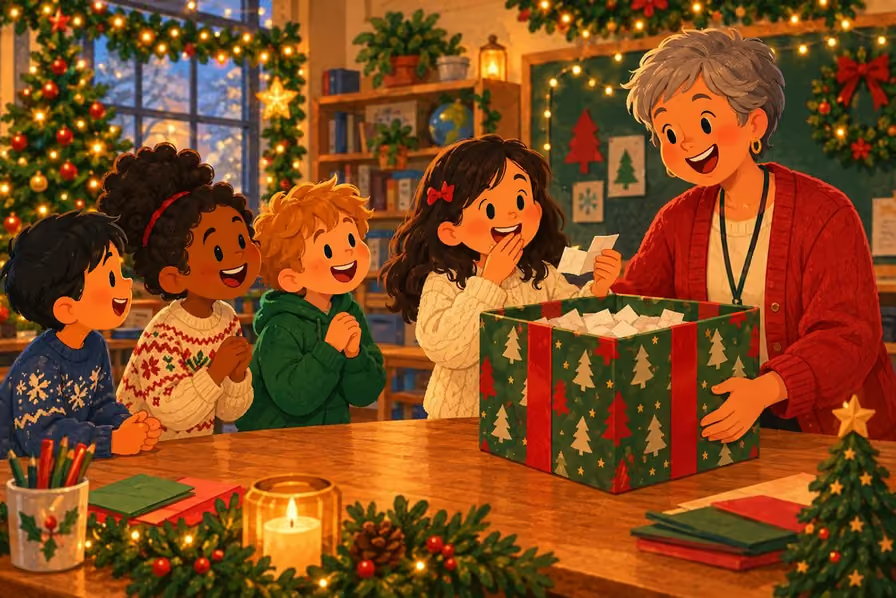
Ages 5 to 7: let the grown-ups hold the secret
Children this age rarely keep a secret for weeks, so use a shuffled row, which makes self-draws impossible:
- 1Write each joining child's name on a card and check the count against your reply list.
- 2Shuffle the cards and lay them in a row, before the children arrive.
- 3Each child gives to the next card in the row, and the last gives to the first. Nobody draws themselves, and with three or more children no two kids draw each other.
- 4Seal each child's match in an envelope with their name on it and send it home to the parent, with that classmate's About Me card if you've made them.
You'll know every match, which is handy for spares but means you can't play. To take part, use the online draw.
Ages 8 to 10: paper slips with a few safeguards
By eight or nine, most children can keep a slip private for a week or two, so draw one to two weeks before the exchange. Our guide to drawing names for Secret Santa has the full hat procedure. A classroom needs these changes:
- You write the slips, not the kids, because handwriting gives people away. Use identical paper, fold every slip the same way and count them against your reply list.
- Kids draw one at a time at your desk while the others work, so classmates can't tell who joined.
- A child who gets their own name swaps with no announcement. If the last slip is the last child's own name, swap it with a child who has already drawn.
- Seal slips for absent children in an envelope, and send every name home sealed or copied onto a card, because slips get lost between school and home.
Any age: an online draw with a parent's email
An online draw works at any age because each match goes to a parent's inbox. The parent tells the child, and you never see the pairs, so “who has me?” gets an honest “I don't know.” Amazing Secret Santa is free and needs no account for anyone, and our walkthrough of how Amazing Secret Santa works covers every screen.
The class-specific details: enter each child as first name plus last initial (“Maya R.”) with a parent's email, since names must be unique (two Emmas become “Emma B.” and “Emma T.”). Put the limit in the budget field (40 characters, such as “$10 max, tax included”), add the date and paste your note. You'll see whether each email went out, but not whether it landed in spam, so ask families to reply “got it” within two days. A lost email can't be re-sent for one child. Ask the family to search their inbox, spam and promotions folders first; if it's truly gone, the only fix is a new draw for everyone, and you tell all families to ignore the first email.
Every email also carries a link to the anonymous chat, which you can't leave out. It has two channels, one with a child's own Secret Santa and one with their gift recipient, so a giver can ask questions without being unmasked. In a class the parent holds the link, so it's parent to parent: a giver's parent can ask about favorites or allergies. It sends no notifications, so a message is only seen when someone opens their own link.
You can add yourself to the draw, because you won't see the pairs. Check your school's policy on staff accepting gifts first, and decide how the child who draws you stays within the limit. From about age 11, students can use their own address if school policy allows.
Siblings, clashing friends and odd class sizes
Exclusions work one way, so to keep twins or siblings from drawing each other, tick each one on the other's list. The same trick separates two children going through a rough patch, and nobody sees it. Our guide to Secret Santa exclusions shows where the limit is.
An odd number of children is no problem: everyone gives exactly one gift and gets exactly one. A draw needs at least 3 people and supports up to 30, so with fewer than three, run a gift-free version for everyone. Past 30, split into separate draws, as how many people you need for Secret Santa explains.
How do you make sure every child gets a gift?
Track recipients, not givers, and keep a few spares ready. Even when you know the pairs, the reliable check is which names still have no parcel.
- 1Set the gift due date for the day before the exchange, so there's a buffer.
- 2Keep a class list and tick a name when a gift labeled “To: name” arrives. Store the gifts out of sight.
- 3Once the gifts are in, wrap a spare for every name still unticked. Families wrap at home, so make it look like the others: plain paper is safest.
- 4Put spares on desks like any other gift. Nobody has to learn that one was a spare.
- 5If the real gift turns up before the party, use it and keep the spare. If it turns up later, give it a few days after. No redraw is needed.
Spares come from the cover fund in the budget section: two or three gifts bought before the letter goes out. Flat, neutral items such as a scratch-art sheet or a maze book make good spares. Wrap only what you need.
Nudging the missing giver depends on the draw. With slips or the online draw you can't tell who it is, so remind the whole class and keep it light; with the teacher-run draw you do know, and a private word works better. A child who's absent gets their gift on return. If a child withdraws after the draw, the fixes in what to do when someone drops out of Secret Santa apply: a fresh draw if nobody has shopped yet, a private “close the gap” fix through you if they have.
Which gifts work in a classroom?
The safest classroom gifts are small, flat, non-food and easy to price-match, so a child is happy to open one whoever gave it. They also have to pass your letter's rules: nothing edible, noisy, messy or full of small parts. Here are four that fit all of that:
- Mini flip-book kit, $4-$8. Draw a few frames, flick the pages, watch them move.
- Pocket-size drawing pad with a pencil and eraser, $3-$6. Fits any backpack.
- Scratch-art sheets with a wooden stylus, $4-$7. Bright results, no ink or glue.
- Pocket maze or dot-to-dot book, $3-$5. Flat, quiet and easy to start the moment it's unwrapped.
For the rest, Secret Santa gifts for kids has a table of picks that suit a whole class plus ideas for each age band, and Secret Santa gifts under $10 has more at this price.
To help givers personalize without guessing, have each child make an About Me card: three favorites and one thing they'd rather not get. With a teacher-run draw, tuck each recipient's card into the sealed envelope. Otherwise you can't pass a card on without learning the match, so pin the cards up from draw day until gifts are due, where parents can find their child's match at pickup.
What does exchange day look like?
Open the gifts together, say thank you first, reveal gently and finish with something the whole class does. This plan fits 45 minutes; the shortened version fits 30.
| Minutes | What happens | Notes |
|---|---|---|
| Before the bell | Put each gift, spares included, on its recipient's desk | Spares were wrapped the day before |
| 0-5 | Circle up and read the four class rules | Keep them on the board |
| 5-10 | Each child writes a guess at their Santa and keeps it | Optional, fun to check later |
| 10-25 | Open the gifts, all at once or one at a time | See the tradeoff below |
| 25-35 | Reveal the Santas and say thank you in person | A Santa who'd rather stay secret can pass |
| 35-45 | Thank-you cards or drawings, tidy up, closing circle | Collect wrapping paper in one bag |
Class rules for the board
Your Secret Santa stays secret until the reveal.
Say thank you first. Whether you like it can wait for later.
Every gift was chosen with care, so we don't compare.
No peeking at tags and no trading.
All at once or one at a time? One at a time builds suspense but spotlights each child's face, which is hard if a gift disappoints, and it takes longer. All at once on a count of three is quick and calm. I'd pick all at once for the youngest and one at a time for older kids, who can handle the audience.
Children who aren't taking part need a real role, not a seat at the side: gift courier, music helper or thank-you card collector. Should they get something? If their family is happy with it, a kind note from you or the class includes them without a gift that marks them out. Ask first, and don't announce it.
For the 30-minute version, drop the warm-up guess and send the thank-you cards home. Check your school's photo permissions before anyone takes a picture.
What class gift exchange ideas work instead of Secret Santa?
If money or participation is the sticking point, keep the draw and change what's exchanged. Most of these cost almost nothing, and none leaves a child empty-handed.
| Format | Cost | How it goes |
|---|---|---|
| Kind-note swap | $0 | Draw names; each child writes what they like about their classmate |
| Secret pal week | $0 | Draw names; for a week each child does small secret kind acts for their pal |
| Handmade swap | $0-$3 | Make bookmarks or paper snowflakes in class, then draw who gets which |
| Book exchange | $0-$5 | Each child wraps a finished book, new or used, and draws one from the pile |
| Class gift to charity | Optional | The class picks a local food drive or shelter and brings a donation |
Skim kind notes before they're delivered and give writers a sentence starter, such as “I like it when you...”. Check your school's policy before collecting money or goods for charity. A White Elephant game, where gifts get stolen, is a hard sell for young children, so save it for older classes. For all 11 formats, classic Secret Santa included, see Christmas gift exchange ideas. Most still start with a draw, so the steps above apply.
Putting it together: a four-week plan
Four weeks gets you from letter to exchange without a scramble:
| When | What to do |
|---|---|
| Four weeks out | Check school rules, set up spares and the cover fund, send the letter, start the About Me cards |
| Three weeks out | Replies due: check in privately with families who haven't answered. Run the online or teacher-run draw |
| Two weeks out | Draw slips now if you're using them. Open the making table |
| One week out | Send a reminder yourself, since the draw sends none |
| The day before | Collect gifts, tick names and wrap spares for any gap |
| Exchange day | Run the 30-45 minute plan |
When the replies are in, draw names online for free and paste the note from above into the event details. If the staff room wants in too, run it as its own exchange with its own draw: optional, a low ceiling, everyone included. The organizer and the principal can both play without seeing the pairs, and the HR guide to Secret Santa at work covers the rules, budget and announcement.
Back to your 26 eight-year-olds. The gifts will matter less than the setup: a number in writing, a way out that takes no explaining and a spare in the drawer. Get those right and a $5 flip-book kit, chosen on purpose, does the job just fine. So does a drawing folded in half.
Frequently Asked Questions
5Most classes pick a limit between $5 and $10, a common convention rather than a rule, and a flat $5 is the easiest yes for families. Write it as one number with tax included, call it a ceiling, and let a handmade gift count as much as a bought one.
There's no single rule, because it depends on your school and district. Before announcing anything, ask your principal whether classroom gift swaps are allowed, whether a holiday activity needs approval and whether parents' email addresses can go into an outside website. Having the answer in writing helps if a parent asks later.
You can if you use an online draw, since the organizer never learns the pairs. Some schools limit what staff may accept, so ask first, and keep a child's gift to you inside the same $5-$10 limit. With the teacher-run draw for little ones you know every match, so sit it out.
No. Amazing Secret Santa needs an email address for each person but no account, so enter a parent's address for each child. The match arrives there, the parent tells the child, and nobody sees the pairs on screen, you included. Check your school's rules on sharing student details first.
Talk to them privately, never in front of the class. Say it's fine to feel let down, then point to the effort: a classmate thought of them and wrapped something. Rehearsing “thank you first” before the party helps, and so does a shared closing activity. Avoid swapping gifts on the spot, which tells the giver they got it wrong.