27 Secret Santa Gifts for Kids Under $20, by Age
In short
The best Secret Santa gifts for kids match the child's age and stay under the group's cap: $5-$10 for a classroom swap, $10-$20 for a family one. Think picture books and play dough at 3-5, craft and science kits at 6-8, and drawing sets or model kits at 9-12. Always check the age label, skip small parts for anyone under 3, and ask a parent when you don't know the child.
| Age | What they love | Gifts that land | Typical price |
|---|---|---|---|
| 3-5 | Pretending, mess, being read to | Picture books, play dough, dress-up, bubbles | $3-$15 |
| 6-8 | Collecting, making, showing off a new skill | Craft kits, chapter books, yo-yos, science kits | $5-$18 |
| 9-12 | Hobbies, independence, not looking babyish | Drawing sets, model kits, graphic novels, sports gear | $8-$20 |
| Whole class | Fairness above everything | Pencils, stickers, bubbles, mini craft kits | $5-$10 |
You unfold the slip of paper and it says “Maya, age 8.” Now you're standing in a toy aisle with $15, trying to work out what Secret Santa gifts for kids look like these days, and whether eight-year-olds still like stickers or have moved on to something you've never heard of.
Shopping for a child is a different job from shopping for an adult. The recipient usually can't, or won't, hand you a wish list, the person who really judges the gift is often a parent, and a present that's two years too young (or too old) lands with a thud. There's also a safety angle that adult exchanges never have.
This guide sorts 27 ideas into three age bands (3-5, 6-8 and 9-12), nine per band, each with a realistic price. Then it covers the parts most lists skip: how to check a gift is safe, which picks work for a whole classroom, and how to let kids be the Santa instead of only receiving one.
How much should a kid's Secret Santa gift cost?
Most groups cap kids' gifts at $10-$20 in a family exchange and $5-$10 in a classroom swap. Those are common conventions, not survey data, and they work as a ceiling: get close to the number, but don't go far past it.
If tax nudges the total a dollar or two past the cap, nobody will mind. A $35 gift sitting next to a $10 one is another story. Kids often compare presents the moment the paper comes off, so a visible gap is awkward for the child on the short end and for the adult who has to explain it. Many groups don't count shipping toward the cap, so confirm that with the organizer before you shop online.
What does the money buy? Around $5-$10 gets a picture book, a play dough set, a sticker book or a bubble kit. From $10-$15 you're into craft kits, small building sets and plush animals. At $15-$20 you can stretch to a bigger kit, some sports gear or a bundle of two small things. If your cap is lower than you'd like, our list of Secret Santa gifts under $10 has more options, and the Secret Santa budget guide explains how groups settle on a number.
What are the best Secret Santa gifts for kids ages 3 to 5?
At 3 to 5, the winning gifts invite pretend play, a little mess or a lap to sit on. Preschoolers rarely need a clever toy. They need one that works right out of the box, because attention spans are short and the unwrapping is half the fun.
- Picture book with rhythm or repetition, $5-$12. Read-aloud books with a rhyme or a repeating line are the ones kids ask for again, and again, and again.
- Play dough set with a few cutters, $6-$12. Many play doughs contain wheat, so ask the parent if gluten is a concern.
- Chunky crayons or washable markers with a drawing pad, $5-$10. Fat crayons suit small hands.
- Bubble wand and solution, $3-$8. Works on a porch or in the bathtub. Spills are part of the deal.
- Water-reveal painting pad, $6-$12. A brush and plain water bring the colors out, so you get art with very little mess.
- Dress-up piece, $8-$15. One item (a cape, a crown, animal ears) beats a full costume, because kids this age put it on and become someone.
- Push or pull-back toy vehicle, $5-$12. Choose a sturdy one with no tiny add-ons that could come off.
- Sticker scene book, $5-$10. Look for a 3+ label, and for reusable stickers that can be moved around so the fun lasts.
- Soft plush animal, $10-$15. Pick one with stitched eyes, which don't pop off.
One rule before you buy anything for this age: read the age label, and treat a 3+ label as the minimum, not a suggestion. Anything with small parts is off the table for a child under 3, and for a four-year-old who shares a home with a toddler.
What are the best Secret Santa gifts for kids ages 6 to 8?
Between 6 and 8, kids start to collect things, care about real skills and shy away from anything that looks designed for babies. Gifts that let them make something or show something off tend to win.
- Early chapter book or the first book in a kids' series, $6-$12. A good pick if the child reads alone. Ask a parent about reading level if you can.
- Friendship bracelet or bead kit, $8-$15. Everything in the box, a flat table and some patience. Beads are small parts, so this is a gift for this age, not for a toddler sibling.
- Simple science kit, $10-$18. Crystal growing, a mini volcano or a bouncy-ball lab. Check that everything is in the box, since a missing ingredient turns a gift into a chore.
- Explorer set, $8-$15. A magnifying glass, a bug viewer or a kid-size headlamp. Works indoors on a rainy day and outdoors on every other one.
- Small brick-building set, $10-$18. Choose a set that builds one thing, like a vehicle or an animal, so it can be finished in one sitting.
- Skill toy, $5-$10. A wooden yo-yo, a hacky sack or juggling scarves. The gift comes with a project: learn the trick before the next family get-together.
- Joke, riddle or fun-fact book, $5-$8. It gets read aloud to the whole room, which makes it a surprisingly social gift.
- Beginner magic trick set, $8-$18. Half of the gift is the audience.
- Origami or paper-airplane kit, $5-$12. Folded paper, clear steps and nothing to lose under the sofa. It turns into show-and-tell by the end of the afternoon.
What is a good Secret Santa gift for an 8-year-old?
A make-it, read-it or do-it gift with an everyday theme such as animals, space or drawing, plus a small extra so it feels chosen rather than grabbed. A simple formula is one main item and an add-on that together stay inside the cap. Three combinations for a $15 cap:
- A bracelet kit ($10) plus a pack of extra thread ($3)
- A magnifying glass ($8) plus a small bug-and-leaf field guide ($5)
- A yo-yo ($5) plus a beginner trick book ($6)
Interests change fast at this age, so one question to a parent (“What's she into this month?”) beats guessing from any list.
What are the best Secret Santa gifts for kids ages 9 to 12?
At 9 to 12, a gift can fail by being too young. Kids this age are building an identity around what they like, so a hobby starter usually beats a toy, and a gift that says “I took you seriously” beats one that's merely cute. For kids who already act like teenagers, our list of Secret Santa gifts for teens picks up where this one stops.
- Sketching set, $10-$18. Graphite pencils of different hardness, an eraser and a small pad. A step up from a coloring set without being intimidating.
- Graphic novel or how-to-draw book, $8-$15. Paperbacks are cheap and rarely wrong if you know one thing they like, such as animals, adventure or humor.
- Model-building kit, $10-$20. A wooden glider, a rubber-band car or a small robot arm. The build is the entertainment.
- Clay starter set with tools, $12-$20. Choose air-dry clay for a no-oven gift. Polymer clay needs baking, so that one is for a parent to approve.
- Tie-dye or fabric-marker set with a plain tote bag, $10-$20. Making their own bag is the point.
- Sports ball with a pump, or a jump rope with a counter, $10-$20. Pick the sport you know they play: a soccer ball for a basketball kid is a missed pass.
- Beginner electronics kit, $12-$20. A few simple circuits, like a buzzer or a light, built on a board. Check the age label and whether batteries are included.
- Collectible figure or mystery bag, $8-$12. Only if you know they already collect. Otherwise skip it, because a collection is personal.
- Battery-powered string lights or a star-projector night light, $10-$20. Many kids this age start caring about how their room looks.
Interests at this age run deep and specific, so one fact from a parent (“he's into space,” “she draws foxes”) beats any list. Match it to the nearest idea above and check the age label.
How do you shop for a kid you barely know?
Ask a parent. One short text removes most of the guesswork, and parents are usually glad someone checks before buying. Keep the questions to two so it takes thirty seconds to answer.
Message to a parent
Hi Parent's name! I drew Child's name in the family/class Secret Santa, and the budget is $15. Two quick questions so I get it right:
- What is Child's name into right now?
- Anything I should avoid (allergies, things they already have, toys that are too young or too old)?
Please keep it between us, since I'm supposed to stay a secret!
If the exchange runs through an online draw, you can ask without revealing yourself. Each draw email from Amazing Secret Santa carries your own chat link, and from there you can message your gift recipient without them knowing it's you. When a parent's email stands in for the child's, the parent opens the child's link and answers. The catch is that nothing alerts them when you write, so your question waits until they look. Ask the organizer to remind parents, in the group chat for example, to check it before shopping time.
Pick by verb, not by gender
Toy aisles split into pink and blue are often driven by marketing, while a child's interests follow what they like to do. So if you know nothing, choose a verb. Most gifts in this guide fit one of these.
| If they like to... | Try | Typical price |
|---|---|---|
| Make | Bracelet kit, clay set, tie-dye kit, water-reveal painting pad | $6-$20 |
| Build | Small brick set, model kit, beginner electronics kit | $10-$20 |
| Move | Yo-yo, sports ball, hacky sack, push-and-go vehicle | $5-$20 |
| Read | Picture book, chapter book, graphic novel, joke book | $5-$15 |
| Pretend | Dress-up piece, magic trick set, plush animal | $8-$18 |
| Explore | Magnifying glass, bug viewer, headlamp, science kit | $8-$18 |
If you truly can't find out anything, the safest bets at every age are a book, a craft kit with everything in the box, or a skill toy.
How do you check that a kid's gift is safe?
Read the age label first, then run four more quick checks: small parts, batteries, magnets and food. Age labels exist partly for safety and partly because toys are designed around what kids can do at each age, so a toy marked 8+ may frustrate a six-year-old as well as worry a parent.
In the US, children's products meant for kids under 3 can't contain small parts that are a choking hazard, and toys with small parts that are meant for ages 3 to 6 must carry a choking-hazard warning (the CPSC's small parts and labeling FAQ explains both rules). Think about the whole house, too. A gift for a seven-year-old may end up on the floor next to a toddler sibling, and small parts don't read age labels.
| Check | What to look for | Matters most for |
|---|---|---|
| Age label | Matches the child's age; read any warning on the box | All ages |
| Small parts | Nothing that fits through an empty toilet-paper tube | Under 3 and toddler siblings |
| Batteries | Compartment closed with a screw; no loose button batteries | Young children |
| Magnets | No sets of small loose magnets | Young children |
| Food and allergens | Go non-food by default; ask about wheat (play dough) and latex allergies | Everyone |
The toilet-paper tube is a common rule of thumb, not the legal test, but it errs on the safe side.
What do parents quietly hope you won't buy?
Some gifts pass every safety check and still make a parent sigh.
- Anything loud with no volume control. The parent hears it on repeat.
- Loose glitter. It outlives the toy by several years.
- Kits that need extra supplies. If the box says scissors and glue are not included, the parent has just been handed an errand.
- Anything too big to store. A play tent is lovely until it needs a corner of the living room.
- Candy and sweets. Many parents and schools have rules, and allergies make food a gamble.
- A pet, or anything else alive. Yes, someone has to say it.
Which Secret Santa gifts work for a whole class?
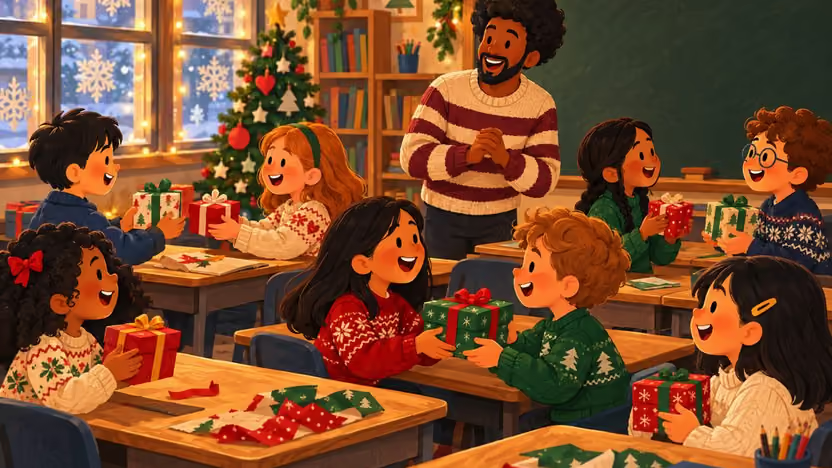
In a classroom, pick small, non-food gifts that suit almost any child and cost $5-$10. Fairness beats personalization here: a seven-year-old who draws a classmate they barely know can't be expected to guess a favorite hobby, so the best class gifts are small things almost every kid enjoys. Very cheap items, like bubbles or a bouncy ball, work best bundled in twos to reach the range.
| Gift | Typical price | Why it works in a class |
|---|---|---|
| Colored pencil set with a sharpener | $5-$8 | Useful at any age and for any interest |
| Reusable sticker book | $5-$8 | Popular with almost everyone and easy to match in value |
| Bubble wand plus a bouncy ball | $5-$8 | Two small things bundled, no skill needed |
| Small paperback or picture book | $5-$8 | The teacher can help match it to a reading level |
| Mini craft kit | $5-$10 | Gives them something to do after the party |
| Jump rope or foam glider | $5-$8 | Works for every kid and gets them outside |
Two rules matter more than the item itself. Put the price range in the note home, so nobody shows up with a $25 gift, and go non-food by default, because of allergies and school food policies. Not every family celebrates Christmas either, so call it a holiday gift swap and make joining optional. Our classroom Secret Santa guide has the parent letter, ways to draw names for each age, spare gifts and an exchange-day plan.
How can kids play Santa themselves?
Let the child choose, but from a short list you've already checked for price and safety. That keeps the fun of choosing and removes the risk of a $4 gift landing next to a $20 one.
The child doesn't need an email address for any of this. In an online draw, a parent's address stands in for the child, so the match arrives in the parent's inbox: the parent tells the child, and the parent can see who it is. That's also why the parent is the natural person to build the shortlist. How much say a child gets depends on age:
| Age | What the child does | What the adult does |
|---|---|---|
| 3-5 | Picks between two gifts, chooses the wrapping paper, adds a drawing | Shops, wraps and keeps the secret |
| 6-8 | Picks from a shortlist of three or four, helps wrap, dictates or writes the card | Builds the shortlist, buys and checks the budget |
| 9-12 | Shops with a set budget, wraps the gift, writes the card | Checks safety and price, drives to the store |
The routine is the same at any age:
- 1Tell them privately once the match arrives, like a mission: “You're Maya's Secret Santa. Your job is to find something she'd love and tell nobody.”
- 2Gather three facts about their person: something they play, something they read or watch, an animal or color they like.
- 3Build a shortlist of three or four gifts under the budget that pass the age-label and small-parts checks.
- 4Let the child choose and wrap it. Lopsided tape is a feature.
- 5Add a card in their own words, or a drawing.
- 6Agree on when the secret ends, so it feels like a game with a finish line.
Picture a seven-year-old who draws her ten-year-old cousin, a kid who is always drawing. The budget is $15. The parent's shortlist is a sketching set ($12), a how-to-draw-animals book ($9) or a fabric-marker set with a plain tote ($14). She picks the tote, wraps it herself and draws a fox on the card.
For the card itself, a drawing plus one line from our Secret Santa card messages is plenty. If the child wants to make something, the DIY Secret Santa gifts list has easy homemade ideas you can adapt so the child does the finishing touches.
How do you run the draw when kids are in it?
Enter each child under their own name with a parent's email, and an online Secret Santa draw works the same way it does for adults. Three details are specific to kids:
- Unique names. Each name can appear only once, so two kids called Anna become “Anna B.” and “Anna R.”
- Siblings, both ways. Exclusions work in one direction, so tick each sibling on the other's list.
- The event details note. It holds up to 500 characters, enough for the budget, a request for no food or small parts for little ones, and the day the secret ends.
The app sends no reminders, so message the group yourself about a week before the exchange. If someone drops out after shopping has started, what to do when someone drops out of Secret Santa has a gentler fix than a new draw. And if kids and grown-ups share one exchange, our family Secret Santa guide covers who joins and what each age spends.
Before you pay, check three things: the age label, whether the kit needs batteries or extra supplies the box doesn't include, and whether shipping counts toward the cap. If a parent hasn't answered yet, buy from the whole-class table above, which needs no clue about the child.
Frequently Asked Questions
5Usually only for older kids, around 10 and up, and only if the group agrees. Younger children get little from an envelope next to the other kids' wrapped gifts. If you go this way, pick a store the child already likes, stay under the cap and add a handwritten note.
Yes, if each skips the other, since the secret is hard to keep in a shared home. Both need the exclusion because it works in one direction only. If the siblings share a parent's inbox, that parent sees both matches. Two siblings alone fall short of the three-person minimum, so use the family draw.
Don't turn it into a lesson on the spot. Let the kids open gifts one at a time and keep the attention on the present in hand. Once the Santa is revealed, the organizer can quietly remind that child's parent about the cap, and next year's invitation can state the budget as one clear number.
Shorten the stretch they have to keep it. For kids under about 6, wait to tell them until it's time to shop or wrap, and reveal within a few days. Older kids hold a secret better with a clear job, like choosing the gift or drawing the card.
Coach the reaction beforehand: say thank you first, and talk about feelings later and in private. Remind them the giver picked it with care on a small budget. If it truly doesn't suit, pass it on or donate it later, without letting the giver find out.