Family Secret Santa: Who Joins, Budgets by Age, Kids and Couples
In short
A family Secret Santa works like any other: everyone draws one name and buys one gift. The family-specific decisions are who is in (kids can get their own draw), a budget by age (commonly $25-$50 for adults, $20-$30 for teens and $10-$20 for kids), couples excluded both ways, and an email address for every relative. Draw two to three weeks ahead.
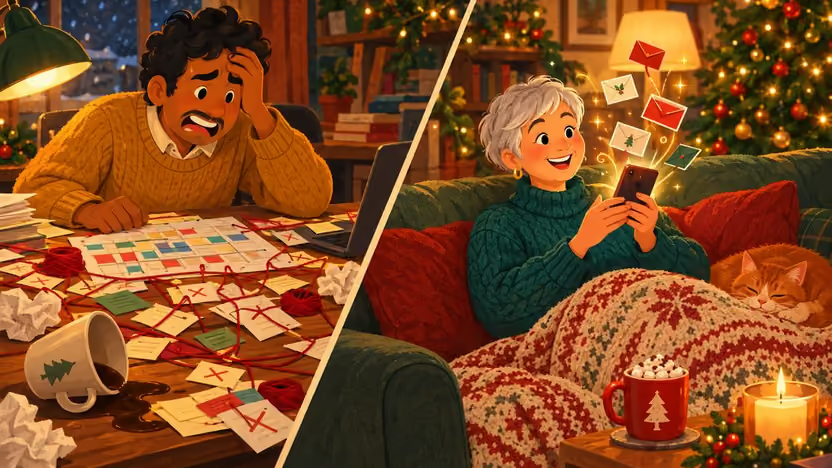
Big family Christmases are wonderful, until you count the gifts. Picture fourteen relatives: grandparents, three couples, a handful of cousins and an aunt who joins by video from another country. If everyone buys for everyone, that's 182 gifts. If everyone draws one name in a family Secret Santa, it's 14.
That arithmetic is the whole case for the switch, and it's also where the trouble starts. A family isn't an office team. Ages run from 4 to 84, couples already shop for each other, one grandparent doesn't use email, incomes differ, and a few kids still believe in the real Santa. Those wrinkles decide whether the exchange feels like a relief or a chore.
This guide settles the decisions that are specific to a family Christmas gift exchange: who is in, what each age should spend, who can't draw whom, how to reach relatives who are offline or far away, and what the day itself can look like. Near the end there's a worked example of a family of 12.
Who should be in a family Secret Santa?
Usually the adults and teenagers, with younger kids either in their own draw or kept out of the exchange. Where you draw the line depends on what your family wants to stop doing. If the pain is a mountain of adult gifts, the adults need the draw and the little ones probably don't.
| Setup | How it works | Works best when |
|---|---|---|
| Adults and teens only | One draw for everyone roughly 13 and up. Younger kids still get presents from parents and grandparents. | Gift fatigue is mostly a grown-up problem and the kids are small. |
| Two draws | One for adults and teens, one for the kids with a lower budget. | You have five or more kids close in age, so the match stays hard to guess. |
| Everyone in one draw | Kids and adults share a pool, and parents help the little ones. | The family is small or the ages are close. |
The strongest objection to any of these is a fair one: grandparents, aunts and uncles who love giving something to every child lose that with a draw. A common compromise is to keep children's presents outside the exchange and use the draw for the grown-up gifts, which is where the spending and the stress usually pile up anyway.
Invite in-laws and partners who will be at the gathering. Leave out anyone who won't, unless they're happy to send and receive a package (more on that below).
How do you set up a family Secret Santa, step by step?
Agree on the rules in the family chat first, then enter the names. The order matters, because it's far easier to settle a budget before anyone has seen their match than after.
A family needs only a handful of rules: the budget is a ceiling, the match stays secret until the reveal, gifts for faraway relatives ship by a set date, and everyone knows which draw they're in.
- 1Float the idea before you announce it. Ask in the family chat whether people want it, and talk first to the relatives who hold the traditions (often a grandparent).
- 2Decide who is in and which draw each person belongs to. Count heads, then place the kids and teens using the setups above.
- 3Agree on a budget for each group, and whether shipping and tax count toward it.
- 4List the exclusions: couples, households, and anyone who would rather not draw a particular person.
- 5Collect a name and an email address for everyone. Where someone has no email, decide whose address will receive theirs.
- 6Enter everyone, add the budget, date and a short note for the group, and send. Then post a “check your inbox” message in the family chat.
For the draw itself, Amazing Secret Santa is free, needs no account and handles three to thirty people. The pairs never appear on screen, so the organizer can play too, and how Amazing Secret Santa works walks through each screen.
One family-specific detail: each name must be unique, and a family can easily contain two people with the same first name. A Maria who is Grandma and a Maria who is a cousin become “Grandma Maria” and “Maria B.” Names take only letters, numbers, spaces, periods, apostrophes and hyphens, so leave out parentheses and ampersands.
How much should each person spend?
A common starting point is $25-$50 for adults, $20-$30 for teens and $10-$20 for kids. Treat the number as a ceiling: spend close to it, don't sweat the dollar or two that sales tax adds, and don't go far over, because at a family table everyone sees every gift. Many groups don't count shipping toward the budget, so say up front which way your family goes.
| Who | Common range | Why that range |
|---|---|---|
| Adults | $25-$50 | One considered gift, not a pile. |
| Teens | $20-$30 | Enough for a real item on their list without making cousins compete. |
| Kids | $10-$20 | A parent is usually paying, and a low cap keeps cousins' gifts similar. |
Mixed incomes are the family-specific trap. Households can be far apart and everyone knows it, so set the ceiling where the tightest household can meet it without thinking twice.
Mixed ages add a second problem: one budget can't fit a 9-year-old and a grandparent. A 9-year-old who draws Grandpa can't realistically spend $40, so parents end up topping up. If the ages are far apart, two draws let each group have its own figure. If you stay in one draw, pick something around $25-$30 and let parents cover the small ones. The figure goes in the budget field of the event details, which fits “$25 max” easily. For overspending and tight budgets, see our guide to Secret Santa budget rules.
What does that budget buy for the grown-ups?
These are starting points, not shopping lists. For the younger cousins, Secret Santa gifts for kids and gifts for teens have full lists.
| Who you drew | Ideas that usually land | Typical price |
|---|---|---|
| Grandparent | Framed family photo, a printed book of family recipes, clip-on reading light | $25-$40 |
| Adult sibling or cousin | A hobby upgrade they'd never buy themselves, movie tickets with snacks | $25-$45 |
| In-law you barely know | Cloth napkins or a set of tea towels, plus a handwritten card. If you pick food, ask about allergies in the chat first | $25-$35 |
You can also just ask. Every email carries a private link to an anonymous chat: you can write to the person you're buying for without giving yourself away, and your own Santa can write to you. It's the right place for allergies, sizes, favorites or a wish list. There are no notifications, though, so tell the family to open their chat link now and then. When your person answers “I don't need anything,” ask what they keep running out of or meaning to replace.
Should couples and households draw each other?
Usually not. Couples and housemates already shop for each other, so a match between them wastes a draw, and the exchange is better when it connects people who rarely give each other much. In the app, tick the partner on both people's lists. Exclusions work one way, so Alice excluding Ben doesn't stop Ben from drawing Alice.
The draw's built-in rule against mutual pairs (if Alice draws Ben, Ben won't draw Alice) doesn't replace this. It only blocks the swap. Ben could still draw Alice while she buys for someone else.
Beyond partners, these are the usual candidates:
- People in the same household, including adult children living at home and roommates.
- Parents and their own children, when both are in the same draw, so each child gets a gift from further out in the family.
- Siblings who already swap gifts on their own.
- Anyone who asks you quietly. A request like “please don't give me Uncle Ray” needs no explanation and no announcement.
Some families skip the exclusions by entering a couple once, as “Alice and Ben” with one shared email address. They buy one gift together and receive one, which suits couples who share everything but leaves them one gift between them, not two.
The app doesn't keep past draws, so ticking last year's match is a by-hand job. It only pays off with five or more people in the draw, and only if the family already knows last year's pairs.
Exclusions also have a ceiling: in a draw of three you can't keep a couple apart both ways, and the app warns you as soon as the exclusions make a match impossible. The guide to Secret Santa exclusions has worked examples for 3, 4 and 6 people and explains when last year's match is worth ticking.
How do you include kids without losing the magic?
Either give kids their own draw with a lower budget, which needs at least three children, or put them in the family draw with a parent managing the email.
A separate kids' draw keeps gifts roughly the same size from cousin to cousin, which matters more than it sounds when seven-year-olds compare. The catch is the minimum, so two siblings can't have one. Pool the cousins instead, ideally of similar ages (a 4-year-old buying for a 12-year-old gets awkward), and set the budget in the $10-$20 range. Even three is thin: only two draws are possible, so a child who sees their match can work out the whole draw. With five or six cousins it starts to feel like a real secret.
Kids without an email address can share a parent's. Enter the child under their own name with the parent's address, and the child's match and chat link arrive in that inbox. The parent knows who the child is buying for, which is usually the point, since someone has to help with the shopping. Teens should have their own address, because a match their mom reads first isn't much of a secret.
Then there's the Santa problem. If your kids still believe in the real one, a game called Secret Santa can get confusing. Call it something else in front of them, such as Secret Elf, and keep the real Santa's presents separate. Children from about six or seven can often play along as someone's elf: let them choose from two or three options a parent has pre-approved, write the card themselves (the Secret Santa card messages have lines for kids, teens and grandparents), and expect the secret to last roughly until bedtime.
What if some relatives are offline, far away or too many for one draw?
Relatives without email borrow someone's inbox, distance changes the calendar more than the rules, and families over 30 split into several draws.
How does a grandparent without email take part?
Enter them under their own name with a trusted person's address, such as their spouse, a child or a grandchild. That person receives the match and passes it on. They'll know who the grandparent is buying for, but not who is buying for the grandparent. They'll also receive the grandparent's anonymous chat link, which means they can read anything the grandparent's Santa writes there. Choose someone discreet, and ask them to check the chat now and then.
How do you include relatives in another city or country?
Draw earlier, ship earlier and open together. When gifts have to travel, draw three to four weeks before the exchange instead of two to three, and set a shipping deadline at least a week before the day. Recipients can share a delivery address in the anonymous chat if they choose to, which keeps the Santa secret while the package still finds the door.
Pick a video call time that works for the farthest time zone, and have everyone open their gifts together. For multilingual families, note that the draw emails are written in the language you're using on the site, not in each person's language, so add a line in the group note for relatives who read another one. Our guide to hosting a virtual Secret Santa has the shipping and call details, which apply to far-flung families too.
What if your family has more than 30 people?
One draw supports up to 30 people, so a bigger family needs several, with everyone in exactly one. Split along the lines of how you celebrate:
- By generation: one draw for the older generation, one for cousins and teens, one for the kids. This works when everyone still gathers in one place.
- By branch: one draw per household or per sibling's family. This works when branches celebrate separately, but it means branches never exchange with each other.
Each draw needs at least three people and runs on its own, with its own budget if you like. The app doesn't merge them, so decide the split before you start entering names. The guide on how many people you need for Secret Santa covers where small and large groups get awkward.
What does a real family draw look like, start to finish?
Here's how a family of 12 might set it up. It's invented to show the choices, not a case study.
Sam, a single uncle, is organizing. The family is grandparents Rose and Walter; their daughter Dana with her husband Marcus and kids Leo (14) and Ivy (9); their daughter Priya with her husband Tom and son Noah (6); and Sam's sister Carla, who lives abroad with her daughter Mia (8) and joins by video. Sam makes two draws: one for the grown-ups, with Leo joining them, and one for the three youngest, the smallest a draw can be.
| Person | Draw | Email goes to | Cannot draw |
|---|---|---|---|
| Rose | Grown-ups | Walter's address | Walter |
| Walter | Grown-ups | His own | Rose |
| Dana | Grown-ups | Her own | Marcus, Leo |
| Marcus | Grown-ups | His own | Dana, Leo |
| Leo, 14 | Grown-ups | His own | Dana, Marcus |
| Priya | Grown-ups | Her own | Tom |
| Tom | Grown-ups | His own | Priya |
| Sam | Grown-ups | His own | Nobody |
| Carla | Grown-ups | Her own | Nobody |
| Ivy, 9 | Kids | Dana's address | Nobody |
| Noah, 6 | Kids | Priya's address | Nobody |
| Mia, 8 | Kids | Carla's address | Nobody |
Rose's email goes to Walter, as in the grandparent section above, and each couple is excluded both ways. Leo and his parents are excluded from each other too, so he gets a gift from further out in the family.
The three cousins need no exclusions. Their draw is easy to crack, but for kids aged 6 to 9 whose parents manage the secret anyway, Sam considers that a fair trade.
Gifts to and from Carla have to cross an ocean, so Sam draws about four weeks before Christmas Eve, in the last days of November, and sets December 15 as the mailing deadline. The grown-ups' draw gets “$30 max” as the budget, December 24 as the date and this note:
Group note for the grown-ups' draw
Welcome to our family Secret Santa! Keep your gift under the budget above and have it wrapped for Christmas Eve at Rose and Walter's. Carla joins by video, so any gift to or from her must be in the mail by Dec 15. Your chat link lets you ask the person you're buying for about sizes and favorites. Check it now and then: no notification is sent when someone writes.
The kids' draw gets “$15 max” and a shorter note. Sam asks Walter privately to keep Rose's match to himself, enters himself like everyone else and presses send. He sees whether each email went out, but none of the pairs, so he plays too. One message in the family chat finishes the job: check your inbox, spam folder included.
The result is two draws, a handful of exclusion boxes and four shared inboxes. Twelve gifts, instead of 132.
How should a family Christmas gift exchange go on the day?
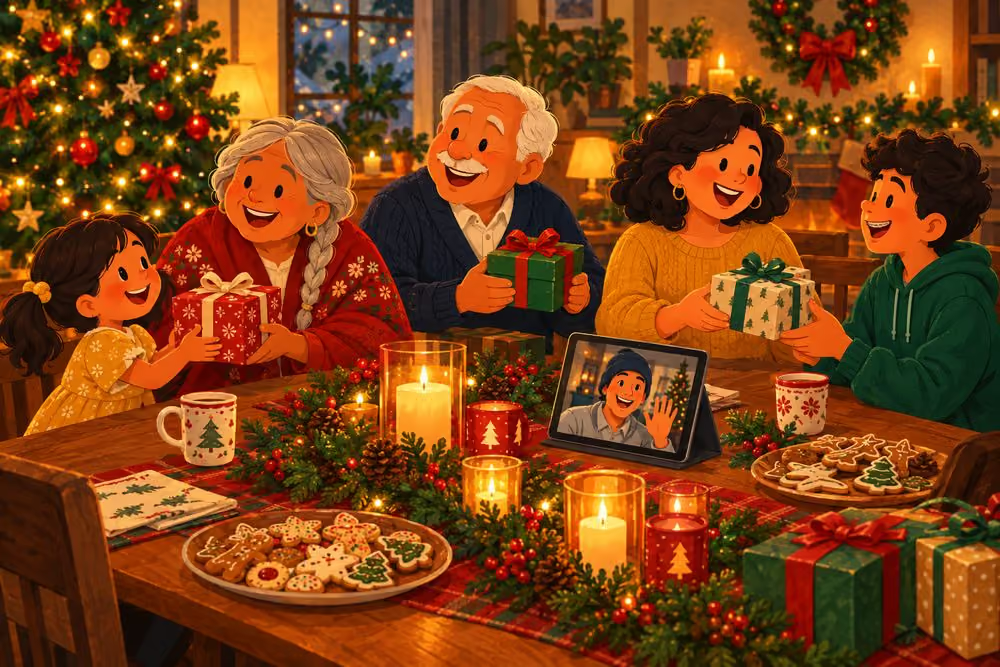
One sitting at the table, one gift opened at a time, and the kids first. Kids' patience runs out soonest, and the exchange only works when everyone watches each reveal, so skip the free-for-all where everyone tears paper at once.

Whoever is up reads the card aloud, guesses who their Santa is, and then the Santa either owns up or stays hidden until the end. Our collection of Secret Santa reveal ideas covers ways to run that part, from guessing games to clue hunts.
One family rule is worth stating before anyone unwraps: say thank you first, and compare gifts never. If a present misses, which happens, a gift receipt slipped into the card lets the swap happen quietly later. With younger children, say the rule out loud before the first gift, because a seven-year-old's honest review of a sweater is hard to take back.
Two twists work well at a family table. Pick one, or use both:
- Memory gift. Alongside the gift, a photo or a few written lines about a moment you shared with the recipient. It costs nothing, so it doesn't touch the budget.
- One-sentence toast. After each reveal, the Santa says one thing they like about the person they gave to. It works across ages and lets quieter relatives say something kind out loud.
When should you draw, and what if someone drops out?
Draw two to three weeks before the exchange, or three to four if gifts have to ship, with the mailing deadline at least a week before the day. Add a reminder of your own about a week before, since the app sends none.
If someone drops out before anyone has shopped, a new draw without them is the simplest fix. Once shopping has started, leave the draw alone: the person who drew the dropout can buy for the dropout's recipient instead, arranged privately through the organizer, or the organizer can buy a backup gift. What to do when someone drops out of Secret Santa has the steps.
Before you press send, check four things:
- The yes list is final, and each draw has at least three people.
- Every relative has an inbox, borrowed ones included.
- The budget and the shipping deadline are in the group message.
- Couples are ticked on both lists.
Fourteen gifts instead of 182, and everyone at the table still opens one picked just for them. Once those four are true, draw your family's names online for free and post the “check your inbox” message in the family chat.

Not sure what to buy?
Find a handmade gift on Etsy, from funny to cozy, for every kind of person.
Frequently Asked Questions
5Yes. If nobody has shopped yet, add them and draw again, then ask everyone to disregard the first email. Tick the newcomer and their partner on each other's lists, both ways, because exclusions only work in one direction. Once shopping has started, a small swap works only if the people involved agree.
Ask the organizer privately to tick each of them on the other's list, so the draw never pairs them. Do it both ways, because an exclusion works in one direction only. Nothing has to be announced in the family chat. In a small draw, watch for the app's warning, since every tick shrinks the possible matches.
Yes, if the family agrees. Kids who sit outside the draw keep getting presents from parents and grandparents, and a small extra from a grandparent is part of that. If the kids are in a draw, give every grandchild the same extra, so the cousins' piles stay even and nobody compares.
Let them sit out without giving a reason. Tell the family chat that anyone can say no to the organizer privately, so nobody has to decline in front of everyone. They can still come to the exchange and share the cookies. Draw only once the yes list is final, and make sure at least three people remain.
Yes. The app works for any occasion, so Hanukkah, a birthday weekend or a summer reunion all fit. In the event details, enter the exchange date you actually need, up to two years ahead, and name the occasion in the group note, which holds up to 500 characters.